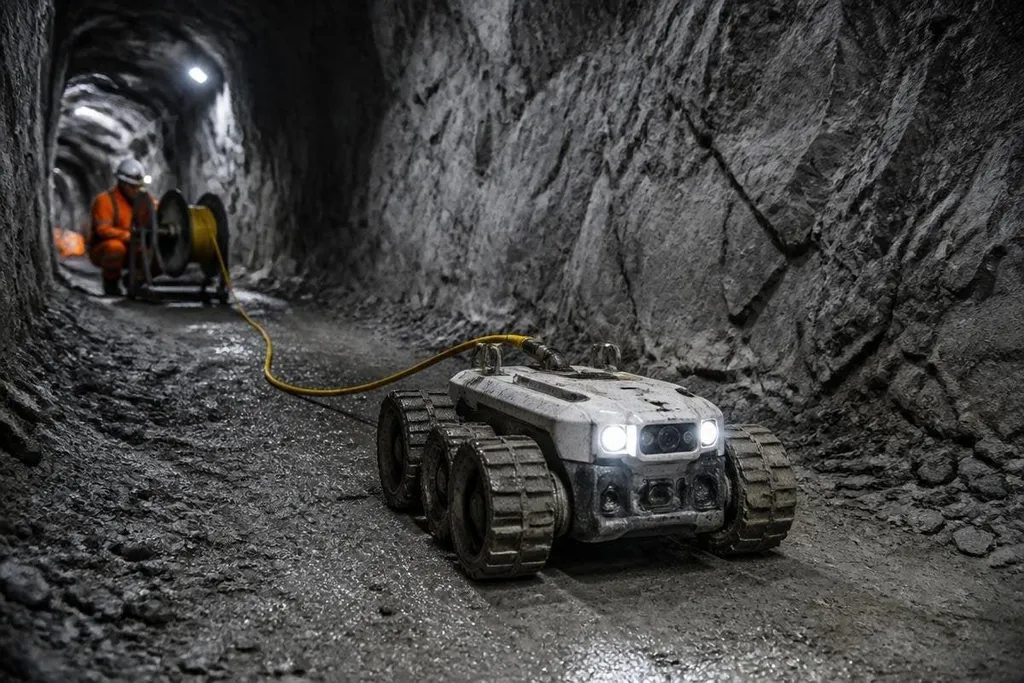
Far below ground, a robot loses the tools that guide most outdoor machines. GPS signals cannot pass through rock, and radio links weaken quickly, so underground robots must measure their own movement and keep a hard link to the surface.
This matters to mine operators, tunnel teams, and inspection crews choosing equipment for places people cannot safely reach. The robot has to find its way, send useful data back, and return after dust, water, heat, and rough ground have tested every part.
Quick read
- GPS stops working underground, so robots build maps from onboard sensors.
- Tethers carry power and data through long tunnels.
- The hardest problem is recovery when the robot loses its route or link.
How the robot knows where it is
An underground robot usually combines an inertial measurement unit, wheel or track movement, cameras, and LiDAR. An inertial measurement unit measures changes in speed and rotation. LiDAR sends out laser pulses and uses their return to measure nearby surfaces.
The robot compares each new scan with earlier scans. This process, called simultaneous localization and mapping, lets it estimate its position while building a map of the tunnel. The map can show walls, roof height, obstacles, and side passages that were missing from old plans.
Movement estimates drift over time. A small error in wheel travel can place the robot several metres from its true position after a long run. LiDAR and camera data help reduce that error, but dust, standing water, repeated wall shapes, and poor light can confuse the sensors.
Fixed markers can give the system a firm location. The robot can use markers placed along a tunnel, a surveyed station, or a known doorway to correct its map. That gives the machine a firm location instead of asking its sensors to guess for the whole trip.
Why tethers still matter
A tether can carry power, data, or both. Fibre optic cable sends video and sensor data over long distances without the same radio limits found in rock. A copper cable can carry more power, but its weight and voltage loss become harder to manage as the tunnel gets longer.
The cable also creates a new failure point. It can catch on a support, drag through mud, or pull the robot off its path. A reel may pay out cable as the robot moves and pull it back during the return, but the reel must match the robot’s speed and route.
Tethered robots often suit inspection work because an operator can receive live video and stop the machine when the route changes. Free-running robots avoid cable drag, yet they need enough battery power to complete the trip and return without a live link.
Underground inspection buyers need more than a live camera feed when choosing between tethered and free-running robots. Reports on underground robots give you named machines and field details to compare before the next section checks the dust and water they must survive.
What the robot has to survive
Water is a serious test. A robot may need sealed housings, protected connectors, and a stated ingress protection rating. That rating describes how well the enclosure blocks dust and water, but it does not tell you how the robot behaves after repeated impacts or long exposure to wet ground.
Heat affects batteries, motors, cameras, and computing hardware. Cold can reduce battery output, while heat can shorten battery life and force the robot to stop. Dust can enter through moving joints or cooling paths, then wear gears and block sensors.
The shape of the robot matters too. Tracks spread weight across soft ground, while wheels can use less power on a firm floor. A legged robot can step over gaps and debris, but its control system has more joints to protect and more motors that can fail.
What happens when the route goes wrong
A useful underground robot needs a recovery plan. It may stop when its map confidence drops, return along its recorded path, follow the tether, or wait for an operator to guide it.
Each choice has limits: the old route may be blocked, the cable may be trapped, and remote control may fail at the same time. The machine also needs a clear record of its position so operators can see the map, battery state, cable length, sensor status, and last known location from the surface.
Without that information, retrieving a stalled robot can become another underground job.
I’d choose a tethered robot for a first inspection where live video and recovery matter more than speed. A free-running design makes more sense after the route, battery range, and return plan have been checked in the same type of tunnel.
Buying checklist for an underground robot
Use these checks before sending a machine below ground:
- Map test: Ask how the system corrects position drift after a long run.
- Link test: Check the rated cable length, data type, and failure response.
- Water rating: Match the enclosure rating to the site’s dust and water.
- Recovery plan: Confirm how staff locate and retrieve a stopped robot.
- Service access: Check how crews clean sensors, replace seals, and change batteries.
The next useful proof is a trial in the actual tunnel, with its dust, slopes, water, and turning spaces. A robot that can map 100 m in a clean test area has not yet shown that it can return from 100 m underground.